


What is the eviction process in Ontario?#
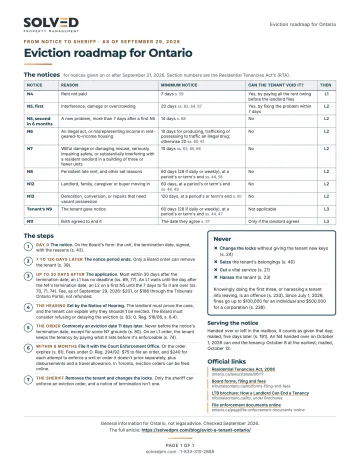
An Ontario eviction has four steps: a notice for a reason the law allows, an application to the Landlord and Tenant Board (LTB), a hearing and order, then the sheriff. A tenancy ends only as the Residential Tenancies Act (RTA) allows, and a landlord can't take the unit back unless the tenant leaves or a Board order allows it (RTA ss. 37 and 39).
The same rules apply without a written lease, since a tenancy agreement can be oral (LTB).
Which eviction notice do you need, and how many days does it give?#
Each reason has its own notice and minimum period, from 7 days for an N4 to 120 for an N13. The N4's 7 days apply to notices given on or after September 21, 2026; most needed 14 before (Tribunals Ontario).
| Notice | Reason | Minimum notice | Can the tenant void it? | Then apply on |
|---|---|---|---|---|
| N4 | Rent not paid | 7 days (s. 59) | Yes, by paying all the rent owing before the landlord files | L1 |
| N5, first | Interference, damage or overcrowding | 20 days (ss. 62, 64, 67) | Yes, by fixing the problem within 7 days | L2 |
| N5, second in 6 months | A new problem, more than 7 days after a first N5 | 14 days (s. 68) | No | L2 |
| N6 | An illegal act, or misrepresenting income in rent-geared-to-income housing | 10 days for producing, trafficking or possessing to traffic an illegal drug; otherwise 20 (ss. 60, 61) | No | L2 |
| N7 | Wilful damage or damaging misuse, seriously impairing safety, or substantially interfering with a resident landlord in a building of three or fewer units | 10 days (ss. 63, 65, 66) | No | L2 |
| N8 | Persistent late rent, and other set reasons | 60 days (28 if daily or weekly), at a period's or term's end (ss. 44, 58) | No | L2 |
| N12 | Landlord, family, caregiver or buyer moving in | 60 days, at a period's or term's end (ss. 48, 49) | No | L2 |
| N13 | Demolition, conversion, or repairs that need vacant possession | 120 days, at a period's or term's end (s. 50) | No | L2 |
| Tenant's N9 | The tenant gave notice | 60 days (28 if daily or weekly), at a period's or term's end (ss. 44, 47) | Not applicable | L3 |
| N11 | Both agreed to end it | The date they agree (s. 37) | Only if the landlord agrees | L3 |
Every form, sorted by situation, is in which LTB form you need.
A notice handed over or left in the mailbox counts as given that day, and a mailed one five days later (RTA s. 191). For example, an N4 handed over on October 1, 2026 can end the tenancy on October 8 at the earliest; mailed that day, October 13.
The earliest termination date for a notice
Arithmetic from the Residential Tenancies Act as amended on September 21, 2026 (ss. 44, 47 to 50, 58 to 68 and 191) and the Landlord and Tenant Board's Rules of Procedure. It isn't legal advice: check the form's own instructions before you fill in a date.
When can a landlord file an eviction application?#
A landlord can apply to the Landlord and Tenant Board right after giving most notices. An L1 waits until the day after the N4's termination date, and an L2 on a first N5 until the tenant's 7 days to fix it are over (RTA ss. 70, 71 and 74).
Most applications must be filed within 30 days after the termination date; one for unpaid rent has no deadline (RTA ss. 69 and 77). An L3 is filed without notice to the tenant and usually decided without a hearing (RTA s. 77; LTB).
As of September 29, 2026, the fee for an L1, L2 or L3 is $201, or $186 through the Tribunals Ontario Portal, and isn't refunded (LTB).
Can the Board refuse or delay an eviction?#
Yes. The Board must consider all the circumstances and decide whether to refuse the eviction or delay it (RTA s. 83). At the hearing, the landlord must prove the case, and the tenant can explain why they shouldn't be evicted (LTB). It must refuse if, for example, the landlord is in serious breach of their duties, or brought the case because the tenant complained to a government authority or tried to enforce their rights (RTA s. 83(3)).
On an L1 filed on or after September 21, 2026, a tenant who wants to raise other issues, such as repairs, must pay the landlord half the arrears claimed (RTA s. 82). The payment and a written description of the issues are due at least 7 days before the hearing (O. Reg. 516/06 s. 8.3; Tribunals Ontario).
Since September 21, 2026, the Board can delay an eviction only if the landlord agrees, or if a delay isn't unfair to the landlord or other tenants and there are compelling grounds. For an N12 or N13, not being unfair is enough (O. Reg. 516/06 s. 8.4). For evidence, deadlines and the hearing day, see what happens at a Board hearing.
When can the sheriff enforce an eviction order?#
From the date the Board's order sets, commonly 11 days after it's issued, the landlord can file it with the Court Enforcement Office, whose sheriff enforces it (LTB). The eviction can't take effect before the notice's termination date, except for some N7 grounds (RTA s. 80).
On an L1 order, the tenant can still keep the tenancy by paying what it lists before it becomes enforceable (RTA s. 74). An order not filed with the sheriff within six months of taking effect expires (RTA s. 81).
The office enforces it as a writ of possession (RTA s. 85) and charges the landlord a fee (LTB). As of September 2026, the fee regulation sets $75 to file an order and $240 for each attempt to enforce a writ or order it doesn't price separately, plus disbursements and a travel allowance (O. Reg. 294/92 ss. 1 and 2). In Toronto, eviction orders can be filed online (Ontario.ca).
- Day 0: The landlord gives the notice on the Board's form (RTA s. 43).
- 7 to 120 days later: The notice period ends, but only an order can remove the tenant (RTA s. 39).
- Up to 30 days after: The landlord applies; an L1 has no deadline (RTA s. 69).
- The hearing: The Board sets it in a Notice of Hearing (LTB).
- The order: Commonly sets the eviction date 11 days after it's issued (LTB).
- Within 6 months: The landlord files it with the sheriff, or it expires (RTA s. 81).
- The sheriff: Removes the tenant and changes the locks (LTB).
How long does an eviction take in Ontario?#
An Ontario eviction takes the notice period, 7 to 120 days, then the Board's process, then the sheriff's step. From October to December 2025, the latest quarter posted, 52% of the Board's English-language cases, all but L5 and A4 rent applications, closed within 90 days of filing, against a target of 80% (Tribunals Ontario; key terms). The sheriff's step comes after the case closes, so that figure leaves it out. For the Board's own hearing and order timelines, see how long an LTB hearing takes.
What can't a landlord do to evict a tenant?#
A landlord can't remove a tenant: only the sheriff can enforce an eviction order, and a notice of termination isn't one (LTB).
A locked-out tenant can call the police or the province's Rental Housing Enforcement Unit, and should file form T2 quickly: once another tenant lives there, the Board can't order the landlord to let them back in (LTB).
Can my landlord evict me?#
Only for a reason the Act allows, and only through the Board. A lease ending isn't a reason: the tenancy simply carries on (RTA ss. 37 and 38). You don't have to move out by the date in a landlord's notice. If you stay, the landlord must apply, and you can dispute it at the hearing (LTB).
With an N12 or N13, you can move out earlier on at least 10 days' written notice (RTA ss. 48 to 50). For advice on your own case, see a licensed paralegal or lawyer, or a community legal clinic.
What to do next#
- Landlords: find your reason in the table, use the Board's current form, and check the earliest termination date. For unpaid rent, see the N4 and the L1.
- Tenants: check the notice's reason and whether you can void it. If you disagree, bring your evidence to the hearing.
- Other reasons: see the N12 for moving in yourself and the N5 for a tenant's behaviour or damage.
- Owners: we draft the notices for the rentals we manage. Get a free rent estimate.


