


Who has to use Ontario's standard lease?#
Most Ontario landlords must use the standard lease: it's required for most residential tenancy agreements signed on or after April 30, 2018 (Ontario.ca; O. Reg. 9/18 s. 2). Its official name is the Residential Tenancy Agreement (Standard Form of Lease).
It doesn't apply to care homes, sites in mobile home parks and land lease communities, most social and supportive housing, co-operative housing, and certain other special tenancies (Ontario.ca; O. Reg. 9/18 s. 1). An agreement signed before April 30, 2018 doesn't need it, even after it renews month to month (Residential Tenancies Act (RTA), s. 12.1(3)). The landlord and the tenant must both sign it on or before the day the tenant is entitled to move in (RTA s. 12.1(2)).
Where do you get the Ontario standard lease?#
You download the standard lease from Ontario's guide to it, which links the form (Ontario.ca). It's Form 2229E, a fillable PDF you can save and print. As of September 29, 2026, the version it links is dated 2020/12, and it's also available in French.
Official sourceResidential Tenancy Agreement (Standard Form of Lease)A landlord can't retype a shorter version. The agreement must set out all the form's contents, in substantially the same format: the introductory note, the 17 sections and the appendix of general information (O. Reg. 9/18 s. 4).
What's in each section of the standard lease?#
The form has 17 sections, then an appendix of general information in parts A to U. The form itself says every section is mandatory and can't be changed; extra terms go in section 15 (Form 2229E). Ontario's guide singles out sections 12, 13 and 14, marked below.
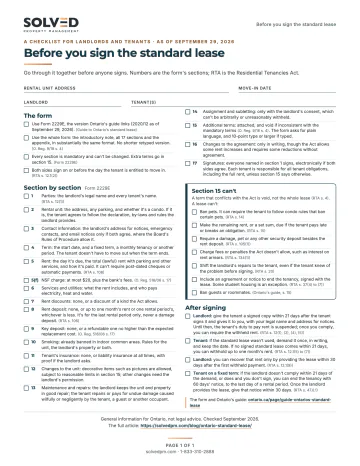
The form, part by part
Residential Tenancy Agreement (Standard Form of Lease), Form 2229E
Version 2020/12, the one Ontario's guide links as of September 29, 2026
- Parties to the agreement: the landlord's legal name and every tenant's name
- Rental unit: the address, any parking, and whether it's a condo. If it is, the tenant agrees to follow the declaration, by-laws and rules the landlord provides
- Contact information: the landlord's address for notices, an optional agreement to exchange notices by email where the Landlord and Tenant Board's Rules of Procedure allow it, and emergency contacts
- Term: the start date, and a fixed term, a monthly tenancy or another period. The tenant doesn't have to move out when the term ends
- Rent: the day it's due, the total (lawful) rent with parking and other services, and how it's paid. It can't require post-dated cheques or automatic payments (RTA s. 108), and an NSF charge is at most $20 plus the bank's fees (O. Reg. 516/06 s. 17)
- Services and utilities: what the rent includes, and who pays electricity, heat and water
- Rent discounts: none, or a discount of a kind the Act allows
- Rent deposit: none, or up to one month's rent or one rental period's, whichever is less, for the last rental period only and never as a damage deposit (RTA s. 106)
- Key deposit: none, or a refundable one no higher than the expected replacement cost
- Smoking: already banned in indoor common areas. Both sides can agree to rules for the unit, the landlord's property or both, such as a balcony (smoking rules)
- Tenant's insurance: none, or liability insurance at all times, with proof if the landlord asks
- Changes to the rental unit: decorative items such as pictures are allowed, subject to reasonable limits in section 15; other changes need the landlord's permission Watch this part
- Maintenance and repairs: the landlord keeps the unit and property in good repair; the tenant repairs or pays for undue damage caused wilfully or negligently by the tenant, a guest or another occupant Watch this part
- Assignment and subletting: only with the landlord's consent, which can't be arbitrarily or unreasonably withheld (subletting) Watch this part
- Additional terms: an attachment with anything extra both sides agree to
- Changes to this agreement: only in writing, though the Act allows some rent increases and requires some reductions without agreement
- Signatures: everyone named in section 1 signs. Each tenant is responsible for all tenant obligations, including the full rent, unless section 15 says otherwise
This is our summary of the form's parts, in the form's order. It isn't the form: fill in the official version.
Get the official formThe appendix covers renewal, ending a tenancy, notices, deposits, rent increases, repairs, entry, guests, pets and smoking. It's general information, not an official reading of the Act (Form 2229E).
Which additional terms can you add to the standard lease?#
You can add terms specific to the tenancy, attached under section 15: work the landlord will do before move-in, say, or rules for common spaces and amenities (Form 2229E). They must not be inconsistent with the lease's mandatory terms, or they're void (O. Reg. 9/18 s. 4).
Ontario's guide asks that they be in plain language, say clearly what each side must or must not do, and be in at least 10-point type if typed (Ontario.ca). It also suggests legal advice before agreeing to any.
Which lease terms are void in Ontario?#
Any term inconsistent with the RTA or its regulations is void (RTA s. 4). Section 4 voids the term, not the whole agreement, and the Act names some void terms outright. Ontario's guide gives examples: no pets, no guests or roommates, deposits or fees the Act doesn't allow, and repairs that are the landlord's (Ontario.ca).
A lease can
- Require the tenant to carry liability insurance (section 11 of the lease).
- Set smoking rules for the unit or the landlord's property (section 10).
- Ask for a rent deposit of up to one month's rent (RTA s. 106(2)).
- Ask for a refundable key deposit no higher than the expected replacement cost (O. Reg. 516/06 s. 17).
- Set rules for common spaces and amenities (section 15).
A lease can't
- Ban pets (RTA s. 14), though it can require the tenant to follow condo rules that ban certain pets (Ontario.ca).
- Make the remaining rent, or a set sum, due if the tenant pays late or breaks an obligation (RTA s. 15).
- Require a damage, pet or any other security deposit besides the rent deposit (RTA s. 105(1)).
- Require post-dated cheques or automatic payments (RTA s. 108).
- Charge fees or penalties the Act doesn't allow, such as interest on rent arrears (RTA s. 134(1)).
- Shift the landlord's repairs to the tenant, even if the tenant knew of the problem before signing (RTA s. 20).
- Include an agreement or notice to end the tenancy, signed with the lease (RTA s. 37(4), (5)).
The rule in section 37 has an exception for some student housing run by or with a college or university (RTA s. 37(6), (7)). For an agreement to end a tenancy later, with or without a payment, see how cash for keys works.
What if the landlord doesn't use the standard lease?#
If the landlord doesn't use the standard lease, the tenant can demand it, once, in writing. If the landlord hasn't provided a signed standard lease 21 days after the demand, the tenant can withhold rent up to one month's worth (RTA s. 12.1(5) to (7)). The landlord can recover it only by providing the lease within 30 days after the first withheld payment (RTA s. 12.1(9)).
When must the landlord give the tenant a copy of the lease?#
The landlord must give the tenant a copy of the lease within 21 days after the tenant signs it and gives it to the landlord, whatever form was used. The lease must also state the landlord's legal name and address for notices (RTA s. 12(1), (2)). Until the landlord does both, the tenant's duty to pay rent is suspended. Once the landlord complies, they can require the withheld rent (RTA s. 12(4), (5)).
What to do next#
- Landlords: download the current Form 2229E from Ontario's guide, fill in every section, keep section 15 to terms that don't conflict with the Act, and give the tenant a signed copy within 21 days.
- Tenants: before you sign, read section 15 against the list above. If your landlord didn't use the standard lease, demand it in writing and keep the date.
- Next in the series: which deposits you can take, then the pet rules.
- Rather have the lease handled? With tenant placement, we prepare the standard lease and walk the tenant through it. Get a free rent estimate.


