


What does a property manager do, step by step?#
A property manager runs the tenancy for you from the listing to the move-out, and follows the landlord's rules under the Residential Tenancies Act, 2006 (RTA) at each step. You stay the owner and the landlord, and you make the big decisions. Each step links its full answer.
- Before listing: Price the unit from what comparable rentals leased for. See how to price your rental.
- Listing and showings: Photos, the listing, and showings by registered real estate agents, with the entry rules if a tenant still lives there.
- Screening: Credit, rental history and income from any source, under the Human Rights Code. See tenant screening.
- Signing: Ontario's standard lease and the last month's rent deposit. See the standard lease.
- Move-in: A dated inspection with photos. See the move-in inspection.
- Every month: Rent collected and paid out, statements, and receipts. See rent receipts.
- When something breaks: Repairs arranged, with notice before entry. See emergency repairs.
- Each year: Renewals, rent increases and the deposit's interest. See rent increases.
- When there's a problem: Notices on the Landlord and Tenant Board's forms, drafted and served. See which LTB form you need.
- Move-out: The tenant's notice, the move-out inspection, and the deposit applied to the last month. See ending a lease early.
What does a manager do before the tenant moves in?#
Before move-in, a property manager prices the unit, markets it, arranges the showings and screens applicants. The screening follows Ontario's rules: a landlord may ask for credit references, rental history and consent to a credit check, and consider income information together with them (O. Reg. 290/98, s. 1).
No decision can turn on a Human Rights Code ground, such as family status, age or the receipt of public assistance (Human Rights Code, s. 2(1)). Income can come from any source: work, self-employment, a pension, benefits, support or savings. See the credit check and when a guarantor can be asked for.
For a unit that still has a tenant in it, showings to prospective tenants without written notice are allowed only after a notice of termination or an agreement to end, between 8 a.m. and 8 p.m., after informing or trying to inform the tenant (RTA s. 26(3)).
What does a manager do when the lease is signed?#
When the lease is signed, the manager prepares Ontario's standard lease, which is required for most residential tenancy agreements signed on or after April 30, 2018, and gives the tenant a signed copy within 21 days (Ontario.ca guide; RTA s. 12(2)). The lease must give the landlord's legal name and the address for notices (RTA s. 12(1)).
It also collects the last month's rent deposit, which can't be more than one month's rent (RTA s. 106(2)), and confirms tenant insurance and the utility transfers before the move-in date.
Official sourceGuide to Ontario's standard leaseWhat happens at move-in?#
The manager inspects the unit with the tenant and records its condition, with dated photos, so the move-out can be compared against it. Neither the Act nor the standard lease requires the inspection, but Ontario's Fire Code does require the landlord to test the smoke alarms and any carbon monoxide alarms every year and after every change in tenancy (O. Reg. 213/07). See what the inspection should record and the alarm rules.
Printable Move-in and move-out inspection Checked September 2026 Download the PDF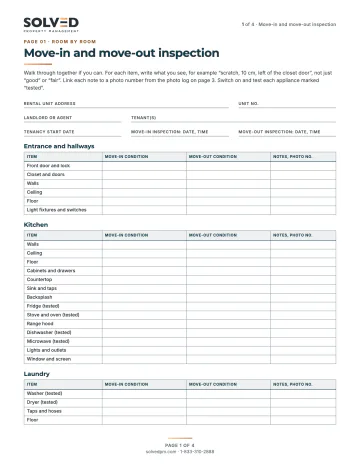
What does a manager do every month?#
Every month, the manager collects the rent, pays it out to you, and sends a statement showing what came in and what went out. A tenant is owed a free receipt for any rent or other payment on request (RTA s. 109), and the manager issues it.
When rent isn't paid, the landlord's notice is form N4. For an N4 given on or after September 21, 2026, the termination date can be no earlier than the 7th day after it's given (RTA s. 59(1); LTB). See unpaid rent and the N4.
What does a manager do when something breaks?#
When something breaks, the manager takes the tenant's call, decides whether it's an emergency, sends a trade and tells you what was done and what it cost. The duty to repair is the landlord's, even for a problem the tenant knew about before moving in (RTA s. 20).
A landlord's agent, such as a person the landlord hires, may enter on the landlord's behalf (LTB Interpretation Guideline 19). For a repair, that takes at least 24 hours' written notice with the reason, the day and a time between 8 a.m. and 8 p.m. (RTA s. 27); in an emergency, no written notice is needed (RTA s. 26(1)). See who pays for repairs.
What does a manager do each year?#
Each year, the manager serves rent increase notices on time and handles renewals. An increase needs at least 90 days' written notice on the Board's form, and at least 12 months since the last increase or the start of the tenancy (RTA ss. 116 and 119). For most units it's capped by the guideline: 2.1% for 2026 and 1.9% for 2027 (Ontario.ca).
The landlord also owes the tenant interest on the last month's rent deposit every year, at the guideline rate (RTA s. 106(6)). When a fixed term ends and nothing new is signed, the tenancy carries on as month to month on the same terms (RTA s. 38(1)); see when a lease ends.
What does a manager do when a tenancy has to end?#
When a tenancy has to end, the manager drafts and serves notices on the LTB's forms, and prepares the application if the tenant doesn't leave. Only the tenant leaving or a Board order lets a landlord take the unit back (RTA s. 39), and a landlord's notice of termination must be on a form the Board approves (RTA s. 43(1)). See how to evict a tenant in Ontario.
At a hearing, a representative must be a lawyer or paralegal licensed by the Law Society of Ontario, or fit one of its exemptions (LTB); we prepare the paperwork, and don't represent anyone at the Board. What to ask a manager before you sign covers who does what at the Board.
What happens at move-out?#
The manager receives the tenant's notice, inspects the unit against the move-in record, and applies the deposit to the last month's rent (RTA s. 106(10)). On a monthly tenancy, the tenant's notice on form N9 is due at least 60 days before a date that's the last day of a rental period (RTA s. 44(2)).
Then it prices and lists the unit again, and the cycle starts over.
What if you live outside Canada?#
The manager who collects your rent is your agent for non-resident tax. The Canada Revenue Agency (CRA) says the payer or agent, such as the property manager, must withhold 25% of the gross rent, or 25% of the net rent once the CRA approves your form NR6, and pay it by the 15th of the next month (CRA T4144).
The agent also gives you an NR4 slip each year. See how to rent out your Ontario home while living abroad and the NR6.
What do you still decide?#
The owner's decisions stay yours: which applicant becomes your tenant, on the manager's recommendation; major repairs and improvements; and whether to raise the rent, sell, or move in yourself. A manager brings you the options and the paperwork, and you make the call.
What to do next#
- Comparing managers? Ask the questions to ask before you sign, and get every answer in writing.
- Weighing the cost? See what managers charge in Toronto, with the calculator.
- Living abroad, or about to? Read renting out your home while living abroad before the first rent is paid.
- Ready to hand it over? Get a free rent estimate.


